
GORE-TEX Application Requirements by System
Each application combines exposure, activity, assembly and care; the material specification should represent those conditions.
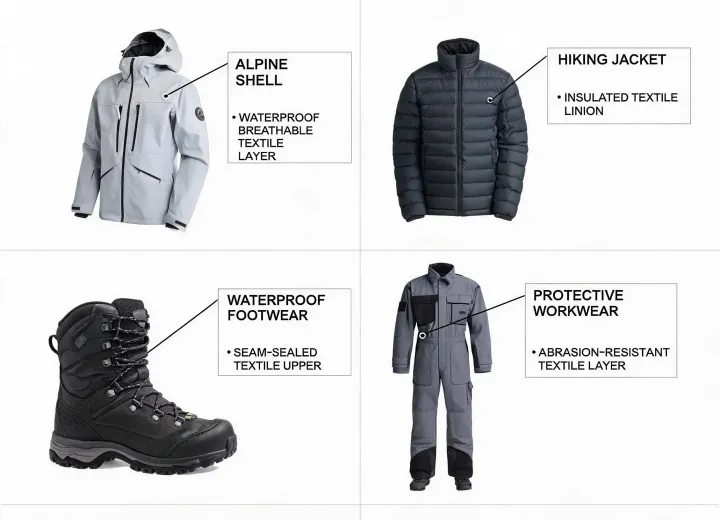
Consider wind-driven rain, pack abrasion, ice contact, movement, venting and long exposure. Material review covers layer construction, hydrostatic-head method, vapor method, face abrasion and aged performance. Garment review covers seam tape, hood, cuff, hem, zipper and ventilation design.
Trade-off: a more protective or robust construction may add mass, stiffness or vapor resistance. No single laboratory value resolves the full balance.
Activity level, ambient conditions, rain duration and garment venting affect moisture management. Compare vapor data only within the same method and conditions, then evaluate fit, layers, openings and real movement.
Trade-off: lighter structures may reduce bulk but can change durability, opacity, handling and seam requirements.
Repeated flexing, lining, adhesives, seams and three-dimensional construction distinguish footwear or glove systems from flat fabric. Test plans should include flex aging and the relevant assembled-product water-entry route.
Trade-off: barrier continuity can compete with flexibility, drying, repair and manufacturing complexity.
Weather protection must be considered alongside abrasion, visibility, contamination, mobility and any job-specific standard. A waterproof-breathable claim does not establish flame, chemical or arc protection.
Trade-off: additional layers or protective functions can alter thermal burden, weight, stiffness and care.
Selection boundary
Results for one layer construction, color, finish or aging state do not automatically cover another. The ordered system and production lot remain the applicable scope.
Application teams should also identify the consequence of failure and the maintenance route. Field exposure, repair access, drying conditions, user layers and inspection intervals can alter the acceptable balance between barrier continuity, vapor transfer, durability, mass and manufacturing complexity.
Align the material method with the product system
Describe exposure, activity, assembly, care, standards and production scope.